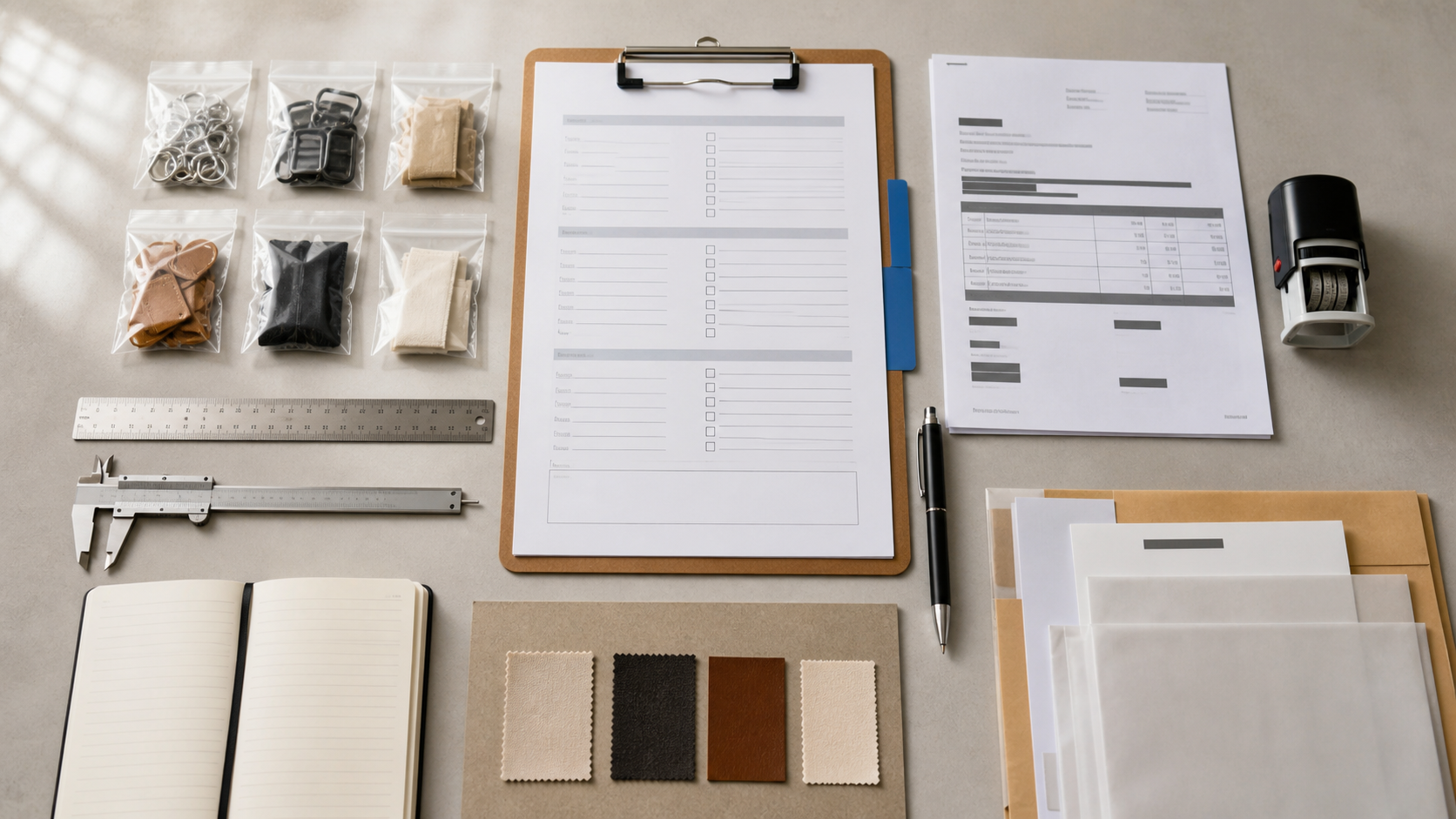
There is no single check that makes a supplier safe. My approach is to build a short evidence trail, then decide whether the remaining risk is acceptable before any money moves.
A company can be registered. Its VAT number can validate. The website can look convincing. None of that tells me whether the person emailing you is authorised, whether the product will meet your specification, or whether the bank account belongs to the legal entity on the invoice.
This is why I treat supplier verification as a decision record, not a set of boxes to tick. It combines several pieces of evidence and states what each piece does not prove.
Use it before a first order, a material deposit, or a new product category. If a check creates a mismatch, I recommend pausing the order. Do not explain the mismatch away for the supplier.
FREE OPERATOR TOOLDownload the fillable wholesale supplier verification checklist (PDF). It works on screen and prints cleanly on A4 paper.
If you are still building your longlist, start with the European supplier discovery guide. If you already have a candidate, use this worksheet alongside the complete supplier-vetting process.
1. Use this checklist as a working record
Copy the table into a spreadsheet. Give every line a status: pass, open, not applicable, or stop. My rule is simple: an item cannot be pass if the evidence is missing or a material discrepancy is still unexplained.
Add six columns beside it:
| Field | What to record |
|---|---|
| Check | The question you are answering |
| Evidence | A saved link, file name, screenshot or call note |
| Evidence grade | Independent, supplier-issued, or observable |
| Checked by / date | Who checked it and when |
| Discrepancy | What does not match, in plain language |
| Decision / next step | Pass, open, stop, or the action needed |
Do not reduce the process to a green tick. A green tick with no evidence is not useful when the contact changes, the order gets larger, or you need to explain the decision to a colleague.
2. 1. Identity: is there a real legal entity behind the offer?
My first check is the name on the quotation or pro forma invoice. Ask for the exact legal entity name, registered address, company number, tax or VAT number where relevant, and country of registration.
Then check an official register in that country. For a UK company, Companies House lets you search by company name, number or officer name and view company data and filing history. For EU VAT numbers, use the European Commission’s VIES validation service. VIES validates whether a number is registered for cross-border EU transactions; it is not a credit check or a supplier endorsement.
| Check | Ask for / verify | What it supports | What it does not prove |
|---|---|---|---|
| Legal entity name | Exact name on quotation, contract and invoice | The party you may be contracting with is identified | That the sales contact works for it |
| Registration number | Number and country, checked on the national register | The entity appears in that register | That it is trading well, owns stock, or owns a factory |
| Registered address | Address on register, invoice and contract | Whether key documents agree | That goods are made or stored there |
| VAT number, if relevant | Number checked through VIES or the relevant national authority | The number is valid for the check performed | That the supplier is solvent or compliant for your product |
| Trading name / website | Trading name linked to the legal entity in writing | The brand name is connected to a named entity | That every website claim is accurate |
My practical test: make the legal entity name appear exactly the same on the quotation, pro forma invoice, purchase order, contract and bank beneficiary confirmation. Small differences can be legitimate. I would still ask for a written explanation before payment.
If the supplier is not incorporated, that is not automatically a reason to reject them. But the decision changes. Identify the actual business form, the individual or entity that will contract with you, and the applicable local register. I would not accept an unexplained “group company” or a logo as the counterparty.
4. 3. Capability: can the supplier make or supply the exact thing you need?
I do not start by asking only, “Are you a manufacturer?” The label is easy to use and often unhelpful.
Ask what role the business plays for your item: manufacturer, distributor, wholesaler, agent or a mix. Then request evidence that fits that role.
For a manufacturer, that may be a production plan, process photos tied to your product, machine list, quality-control process and the ability to arrange a facility audit. For a distributor, it may be current brand authorisation, stock availability, batch traceability and a clear returns process.
| Check | Ask for / verify | What it supports | What it does not prove |
|---|---|---|---|
| Product specification | Material, dimensions, model, finish, pack count, labels and tolerance | The supplier has a defined item to quote against | That the delivered batch will match it |
| Capacity and lead time | Current capacity, production slot, minimum order and lead-time assumptions | Their stated plan for your order | That the slot will remain available |
| Traceability | Batch, lot or serial-number process where relevant | A method for tracing supplied goods | That every item is genuine or compliant |
| Quality process | Inspection points, acceptance criteria and defect handling | That a quality process has been described | That it is applied consistently |
| Audit or live walkthrough | An independent audit, or a live, unscripted video call where appropriate | Observable evidence of premises and process | Full product quality or ongoing compliance |
A polished factory video is supplier-issued evidence. A live walkthrough helps, but it is still not an independent audit. I treat either as one piece of a larger picture, not a reason to assume capability.
5. 4. Product: has the item itself passed a controlled check?
I would not approve a product from photographs alone. Order a sample against a written specification. Put the specification version, sample date, product code and requested changes in one place.
Then inspect what matters to the customer: dimensions, weight, function, materials, finish, packaging, labels, instructions and any claims made on the listing. Photograph the sample. Record failures. Keep the approved version.
An approved sample shows that that sample met your test. It does not prove that the production batch will match. For a meaningful order, I want the purchase order, approved sample, inspection standard and remedy for non-conforming goods to work together.
| Check | Ask for / verify | What it supports | What it does not prove |
|---|---|---|---|
| Sample identity | Product code, version, date and shipping record | You can identify what was tested | Production consistency |
| Written specification | The same specification attached to the quote and purchase order | A shared reference point | Correctness of the finished goods |
| Sample test record | Pass/fail notes, images and measured results | Your evaluation of the sample | Compliance in every market |
| Pre-shipment inspection | Inspection scope, sampling method and report | A view of the inspected shipment | That no defect exists outside the inspected sample |
6. 5. Compliance: is the evidence relevant to your product and market?
Compliance is where generic certificates become dangerous. A certificate may be genuine yet apply to another product, another factory, another version, another date, or another market. I do not mark a document as evidence until I can match it to the item and destination in front of me.
First identify the country where you will place the goods on the market and the product category. For goods placed on the EU market, the European Commission says imported products must meet applicable EU requirements, and some requirements remain national rather than harmonised. I use Access2Markets and the relevant product authority to identify the rules for the specific product and destination. Do not use this checklist as a substitute for category-specific compliance advice.
| Check | Ask for / verify | What it supports | What it does not prove |
|---|---|---|---|
| Product category and destination | Your written category, intended use and markets | Which rules you need to investigate | That the supplier has met them |
| Test report | Full report, lab details, product/model match, issue date and standard cited | Evidence about the sample/product stated in the report | That all future production is identical |
| Declaration or certificate | Issuer, scope, product identity, date and responsible entity | A supplier claim or third-party certification within its scope | Automatic legal permission to sell everywhere |
| Lab verification | Confirm the report with the named lab when the risk or order value justifies it | That the document was issued by that lab | That the report covers every legal requirement |
| Labels and instructions | Artwork and language reviewed for your destination | The proposed presentation can be assessed | That it has been approved by an authority |
If the supplier responds to a precise request with a generic PDF and no product reference, I mark the item open, not pass.
7. 6. Commercial terms: are you comparing and buying the same deal?
I read the quotation line by line before I compare the price. It should state the product, version, quantity, unit price, currency, packaging, lead time, Incoterm and named place, payment schedule, inspection arrangement and remedy for defects.
Do not assume “FOB”, “delivered” or “shipping included” means the same thing across quotations. Ask for the named place and a written breakdown of included and excluded costs. If the product crosses borders, I check the import conditions separately rather than relying on a sales message.
| Check | Ask for / verify | What it supports | What it does not prove |
|---|---|---|---|
| Written quotation | Version-controlled document with all commercial fields | What the supplier has offered | That the offer is commercially sensible |
| Contracting entity | Entity name and address match the order and invoice | Who you expect to pay and contract with | That funds will reach the correct account |
| Payment schedule | Deposit, balance trigger and delivery documents | The stated timing of exposure | That the goods will arrive or pass inspection |
| Incoterm and named place | The exact rule and location, written in the quote | A basis to allocate transport responsibilities | The full landed cost or customs outcome |
| Returns / defects remedy | A written remedy, time window and responsibility | That a route for a dispute has been agreed | That recovery will be easy across borders |
8. 7. Payment: is the destination confirmed independently?
My rule is to treat any change to bank details as a new verification event. This includes a request from an address that looks familiar.
Before a first payment, I confirm the beneficiary name, account details and payment instructions through an independently established contact route. Record the date, number called and person who confirmed it. If the beneficiary does not match the contracting entity, I would stop and get a written explanation that you can verify independently.
Do not let urgency collapse the process. A supplier can reasonably ask for a deposit. Urgency, a new account and pressure to skip normal controls are a risky combination. I would not release payment until that combination has been resolved.
| Check | Ask for / verify | What it supports | What it does not prove |
|---|---|---|---|
| Beneficiary name | Exact legal name on the bank instructions | The stated destination of funds | Ownership or control of the account |
| Independent confirmation | Callback to a verified contact | The instruction was confirmed outside the email thread | That the account cannot later be compromised |
| Payment method | Terms, dispute route and release conditions | Your practical protection and timing | Product quality or supplier solvency |
| Bank-detail change log | Previous and new instructions, confirmation and approver | That the change was controlled | That every future change is genuine |
9. The three evidence grades
Give each line in your record one evidence grade. I use this to avoid treating a catalogue, a registry search and a physical inspection as equal.
| Grade | Examples | How to use it |
|---|---|---|
| Independent | Official company register, official VAT validation, named lab confirmation, independent audit | Stronger starting point. Check scope and date. |
| Supplier-issued | Quote, certificate supplied by the vendor, catalogue, factory video, reference letter | Useful, but seek corroboration for material decisions. |
| Observable | Your sample inspection, independent callback, live walkthrough, pre-shipment inspection | Valuable for the specific thing observed. Record limitations. |
The strongest record usually combines all three. An official registration check, a sample you tested, and an independently confirmed bank instruction tell me more together than three supplier PDFs.
10. Red flags that matter in combination
One awkward detail may be harmless. A pattern is different. I assess the combination, because several small gaps can create one material payment risk.
I would pause the order when I see combinations such as:
- the company name on the invoice does not match the registry record, and the bank beneficiary is a third party;
- a sales contact refuses an independent callback, while asking for a fast deposit;
- a test report does not name your product or version, and the supplier cannot explain the gap;
- the supplier claims to be a manufacturer but cannot describe the process, provide a traceable sample, or arrange an appropriate audit;
- the quote changes materially after the sample, but the supplier will not reissue it with the new terms;
- the contact changes bank details shortly before payment and wants you to reply only by email.
None of these proves fraud by itself. Each is enough for me to stop treating the order as routine.
11. When desktop checks are not enough
Desktop checks are a low-cost first pass. They are not a replacement for looking at the product or operation when the exposure is meaningful. This is where I decide whether the size and type of risk justify more direct evidence.
I recommend an independent audit, sample testing, pre-shipment inspection, or specialist compliance review when any of these are true:
- the product is regulated, safety-critical, consumable, electrical, children’s, cosmetic, medical or otherwise high-risk;
- the order is large relative to the cash you can afford to lose;
- the supplier is new, distant, hard to verify, or selling through an intermediary;
- product quality or traceability will affect your marketplace account or customer safety;
- a key check is incomplete but the opportunity seems attractive.
Choose the scope before appointing the inspector or adviser. “Check the factory” is vague. I would use a brief such as: “Confirm the site exists, the stated production line is present, the product code matches the approved sample, and the report includes dated photographs.”
12. Make the decision and set a re-check date
At the end, I write one of four outcomes:
- Proceed: core identity, authority, product, terms and payment checks agree.
- Proceed with controls: some risk remains, but you have reduced exposure with a sample, inspection, staged payment or smaller first order.
- Hold: a material item is open. Name the evidence needed to release the order.
- Stop: the discrepancies or lack of evidence make the risk unacceptable.
Set a re-check date as well. I recheck before a larger order, a new product, a new market, a material change in payment details, or after a sensible period for the category. Supplier verification is not a badge that lasts forever.
13. FAQ
Is a company registration enough to verify a supplier?
No. It helps confirm that an entity appears in the register. It does not prove that your contact is authorised, that the entity controls the payment account, or that it can make or supply the product you need.
Does a valid VAT number mean a supplier is legitimate?
It supports a narrower conclusion: the number validated for the relevant check. In the EU, VIES is a tool for VAT-number validation. It is not a due-diligence report, credit check or product-compliance certificate.
What documents should I request from a new wholesale supplier?
Start with the legal entity details, quotation, product specification, sample information, relevant compliance evidence, payment instructions and contract or purchase-order terms. The right product evidence depends on the category and the market where the goods will be sold.
How often should I re-verify a supplier?
Recheck when the risk changes: before a bigger order, a bank-detail change, a new product, a new destination market, or a meaningful gap since the last order. Keep the date and evidence from every review.
This article is general operational guidance, not legal, tax, product-safety or fraud-prevention advice. Verify requirements for the product and markets involved before buying or selling.